Simulating future forest resources and the impact of natural disturbances using the EFISCEN-space model
By: Johanna Klapper, Yasmin Maximo, Gert-Jan Nabuurs, Jo Van Brusselen, Pieter Johannes Verkerk
European forests provide a multitude of ecosystem services to society but are increasingly impacted by natural disturbances (Patacca et al., 2023). (Past) forest management and climate change play an important role in the extent, frequency and intensity of disturbance events (Senf & Seidl, 2021; Sommerfeld et al., 2018). To allow a better understanding of future forest ecosystem dynamics and to assess alternative management strategies to improve forest resilience, it is essential to model forest resource development at the European level, under changing climate and management conditions.
The EFISCEN-space model is a high-resolution, spatially explicit forest resource simulation tool developed by Wageningen Environmental Research (WENR) in close collaboration with the European Forest Institute (EFI). In eco2adapt, the EFISCEN-space model is extended to include natural disturbances, such as wildfires and storms.
EFISCEN-Space is under development since 2006 (Nabuurs et al. 2007, 2010), as a successor of the EFISCEN model. Both models are empirical and rely on national forest inventory (NFI) or similar data for parameterization and initialization. For the EFISCEN model, NFI data are aggregated locally, while EFISCEN-space requires tree-level information at the plot level.
The core of EFISCEN-space is the spatially explicit modelling of forest development in Europe at the forest stand level, based on empirical NFI tree-wise plot data, driven by environmental datasets that have pan-European coverage, under forest management conditions. EFISCEN-space is modular, such that depending on the aim of the application, modules can operate on different levels of detail, or can be excluded. The functionality can be extended to cover aspects such as carbon in biomass, soil and harvested wood products, biodiversity & ecosystem services indicators and economic indicators (Schelhaas et al., 2022). Also forest structural variables are calculated (Nabuurs et al. 2026), as well as variables relevant for e.g. nature restoration regulation (Jacobs et al. 2025). EFISCEN-space is not intended to replace existing national models but should be able to simulate the forest of any European country in a consistent way (Schelhaas et al., 2022).
In its current state, EFISCEN-space contains NFI data from 20 European countries, containing more than 400,000 inventory plots and 9 million trees. In addition to the forest plot data, the model uses numerous predictor variables for its simulations, i.e. 41 weather, 43 climate, 10 soil and 3 deposition variables. Based on these input data, the EFISCEN-space model can simulate forest development up until 2100, under various climate change scenarios and forest management interventions (Filipek et al., in prep.). The model runs on climate- and structure-sensitive ingrowth, growth, and mortality functions that have been developed based on repeated NFI measurements across Europe (König et al., 2025; Schelhaas et al., 2018; Schelhaas et al., in prep.). To initialize the model, tree-wise data of individual inventory plots are transformed into a diameter distribution of 40 diameter classes à 2.5cm per tree species (group). The model runs on a yearly scale where each process, i.e. recruitment, In its current state, EFISCEN-space contains NFI data from 20 European countries, containing more than 400,000 inventory plots and 9 million trees. In addition to the forest plot data, the model uses numerous predictor variables for its simulations, i.e. 41 weather, 43 climate, 10 soil and 3 deposition variables. Based on these input data, the EFISCEN-space model can simulate forest development up until 2100, under various climate change scenarios and forest management interventions (Filipek et al., in prep.). The model runs on climate- and structure-sensitive ingrowth, growth, and mortality functions that have been developed based on repeated NFI measurements across Europe (König et al., 2025; Schelhaas et al., 2018; Schelhaas et al., in prep.). To initialize the model, tree-wise data of individual inventory plots are transformed into a diameter distribution of 40 diameter classes à 2.5cm per tree species (group). The model runs on a yearly scale where each process, i.e. recruitment, planting, growth, harvesting and natural mortality, is evaluated each year and the forest plot information updated accordingly for the next year.
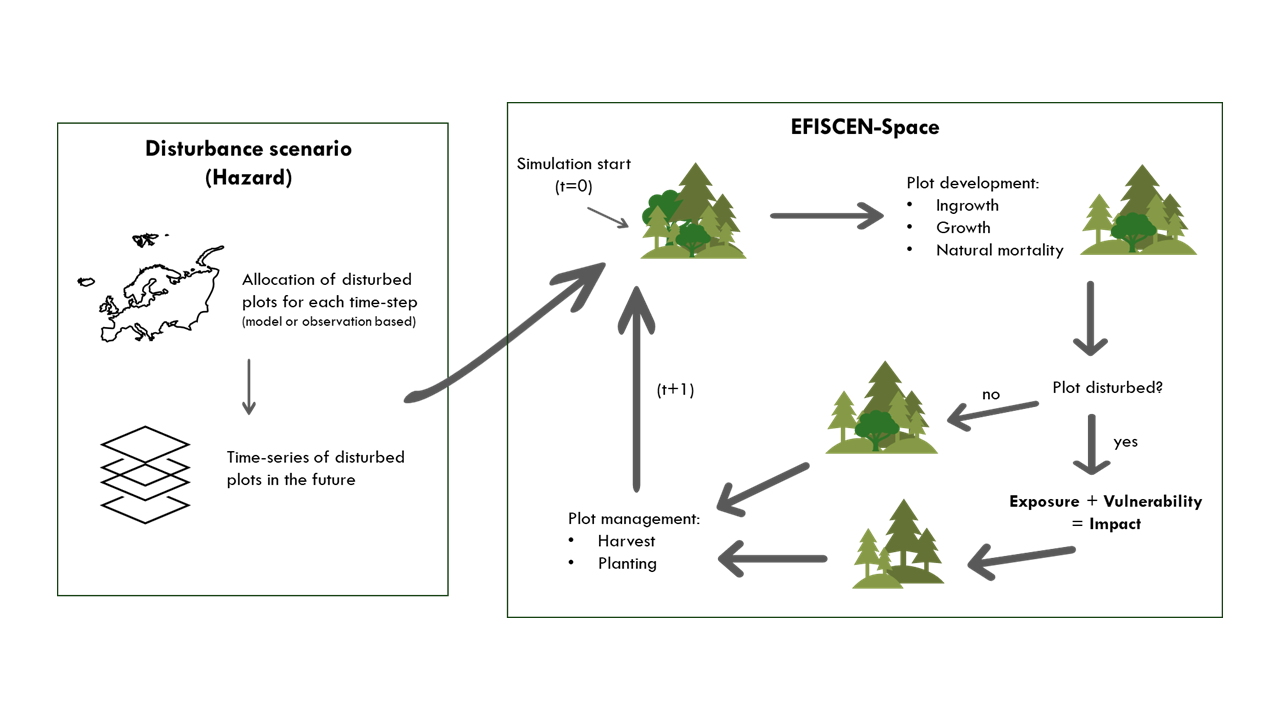
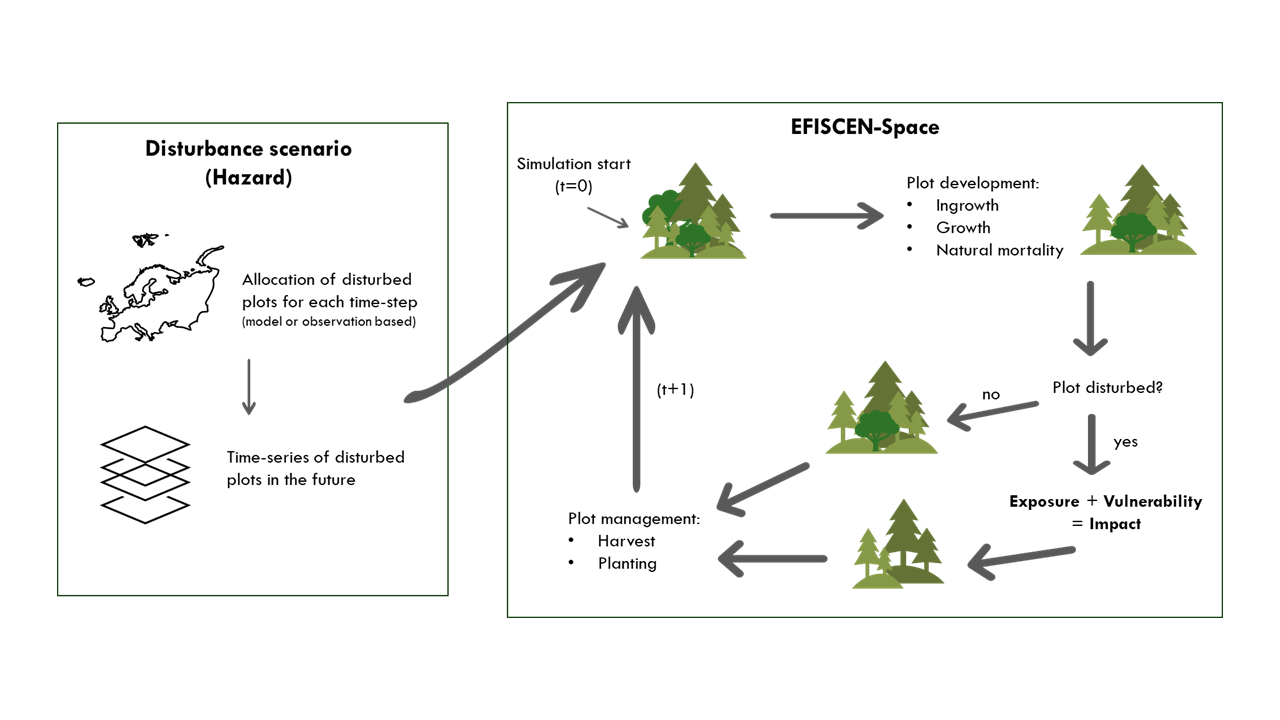
One feature that has been missing in the model at the start of the eco2adapt project in 2022 was the simulation of natural disturbances, such as wildfires and storms. While parallel efforts within the RESONATE project were taken to implement a natural disturbance functionality in the model (Patacca et al., 2025), the work in eco2adapt focuses on integrating a disturbance functionality using the vulnerability models developed by Forzieri et al. (2021) into the EFISCEN-space framework. Both approaches define disturbances as follows: i) hazard = the probability of a forest plot being impacted by a disturbance; ii) vulnerability = the proportion of a forest plot affected by a disturbance, if hit; iii) exposure = the available forest biomass that could be impacted by a disturbance, and all three components combined result in the expected biomass loss per plot (impact) (see Figure 1).
More information about the implementation of natural disturbances in EFISCEN-space and simulation results will be published and shared at a later point – stay tuned!
Figure 1: Workflow of EFISCEN-space, including the implemented disturbance module (adapted from Patacca et al., 2026)
For more information about the forest resource models:
Forzieri, G., Girardello, M., Ceccherini, G., Spinoni, J., Feyen, L., Hartmann, H., Beck, P. S. A., Camps-Valls, G., Chirici, G., Mauri, A., & Cescatti, A. (2021). Emergent vulnerability to climate-driven disturbances in European forests. Nature Communications, 12(1), Article 21399. https://doi.org/10.1038/s41467-021-21399-7
Jacobs, S., Filipek, S., Nabuurs, G. J., et al. (2025). Deliverable D6.5: Projected ecosystem data under varying restoration scenarios. Horizon 2020 project SUPERB (Project No. 101036849). Wageningen Environmental Research; European Commission.
König, L. A., Mohren, F., Schelhaas, M. J., Astigarraga, J., Cienciala, E., Flury, R., ... & Nabuurs, G. J. (2025). Combining national forest inventories reveals distinct role of climate on tree recruitment in European forests. Ecological Modelling, 505, 111112.
Nabuurs, G. J., van der Werf, D. C., Heidema, N., & van der Wyngaert, I. J. J. (2007). Towards a high resolution forest carbon balance for Europe based on inventory data. In R. Freer-Smith et al. (Eds.), Forestry and climate change (pp. 105–111). OECD.
Nabuurs, G. J., Hengeveld, G. M., van der Werf, D. C., & Heidema, A. H. (2010). European high resolution forest carbon balance assessed with inventory-based methods: An introduction to a special section. Forest Ecology and Management, 260, 239–240.
Nabuurs, G. J., ... Schelhaas, M. J., et al. (2026). Contemporary high resolution European forest structure assessed using tree-level National Forest Inventory data. PLOS ONE.
Patacca, M., Grünig, M., Schelhaas, M. J., Alberdi, I., Filipek, S., Fridman, J., ... & Nabuurs, G. J. (2026). Climate-driven increases in wildfire projected to affect European forest types differently. Environmental Research Letters. https://doi.org/10.1088/1748-9326/ae4115
Patacca, M., Lindner, M., Lucas-Borja, M. E., Cordonnier, T., Fidej, G., Gardiner, B., & Schelhaas, M. J. (2023). Significant increase in natural disturbance impacts on European forests since 1950. Global Change Biology, 29(5), 1359–1376. https://doi.org/10.1111/gcb.16541
Patacca, M., Schelhaas, M.-J., Bozzolan, N., Filipek, S., Staritsky, I., van der Sande, M., & Nabuurs, G.-J. (2025). Deliverable 4.9: Report on EU-level forest and wood value chain resilience assessed by three scenarios. Horizon 2020 project RESONATE (Project No. 101000574). Wageningen University & Research.
Schelhaas, M. J., Hengeveld, G. M., Heidema, N., et al. (2018). Species-specific, pan-European diameter increment models based on data of 2.3 million trees. Forest Ecosystems, 5, Article 21. https://doi.org/10.1186/s40663-018-0133-3
Schelhaas, M.-J., Hengeveld, G., Filipek, S., König, L., Lerink, B., Staritsky, I., de Jong, A., & Nabuurs, G.-J. (2022). EFISCEN-Space 1.0 model documentation and manual (Wageningen Environmental Research Report No. 3220). Wageningen Environmental Research. https://doi.org/10.18174/583568
Sommerfeld, A., Senf, C., Buma, B., et al. (2018). Patterns and drivers of recent disturbances across the temperate forest biome. Nature Communications, 9, Article 4355. https://doi.org/10.1038/s41467-018-06788-9
Views and opinions expressed are however those of the author(s) only and do not necessarily reflect those of the European Union or REA. Neither the European Union nor the granting authority can be held responsible for them.
By browsing our site you accept the installation and use cookies on your computer.
Know more
Our use of cookies
Cookies are a set of data stored on a user’s device when the user browses a web site. The data is in a file containing an ID number, the name of the server which deposited it and, in some cases, an expiry date. We use cookies to record information about your visit, language of preference, and other parameters on the site in order to optimise your next visit and make the site even more useful to you.
To improve your experience, we use cookies to store certain browsing information and provide secure navigation, and to collect statistics with a view to improve the site’s features. For a complete list of the cookies we use, download “Ghostery”, a free plug-in for browsers which can detect, and, in some cases, block cookies.
You can also visit the CNIL web site for instructions on how to configure your browser to manage cookie storage on your device.
In the case of third-party advertising cookies, you can also visit the following site: https://www.youronlinechoices.com/fr/controler-ses-cookies/, offered by digital advertising professionals within the European Digital Advertising Alliance (EDAA). From the site, you can deny or accept the cookies used by advertising professionals who are members.
It is also possible to block certain third-party cookies directly via publishers:
Cookie type
Means of blocking
Analytical and performance cookies
Realytics Google Analytics Spoteffects Optimizely
Targeted advertising cookies
DoubleClick Mediarithmics
The following types of cookies may be used on our websites:
Mandatory cookies
Functional cookies
Social media and advertising cookies
These cookies are needed to ensure the proper functioning of the site and cannot be disabled. They help ensure a secure connection and the basic availability of our website.
These cookies allow us to analyse site use in order to measure and optimise performance. They allow us to store your sign-in information and display the different components of our website in a more coherent way.
These cookies are used by advertising agencies such as Google and by social media sites such as LinkedIn and Facebook. Among other things, they allow pages to be shared on social media, the posting of comments, and the publication (on our site or elsewhere) of ads that reflect your centres of interest.
Our EZPublish content management system (CMS) uses CAS and PHP session cookies and the New Relic cookie for monitoring purposes (IP, response times). These cookies are deleted at the end of the browsing session (when you log off or close your browser window)
Our EZPublish content management system (CMS) uses the XiTi cookie to measure traffic. Our service provider is AT Internet. This company stores data (IPs, date and time of access, length of the visit and pages viewed) for six months
Our EZPublish content management system (CMS) does not use this type of cookie.
For more information about the cookies we use, contact INRAE’s Data Protection Officer by email at cil-dpo@inra.fr or by post at:
INRAE 24, chemin de Borde Rouge –Auzeville – CS52627 31326 Castanet Tolosan cedex - France